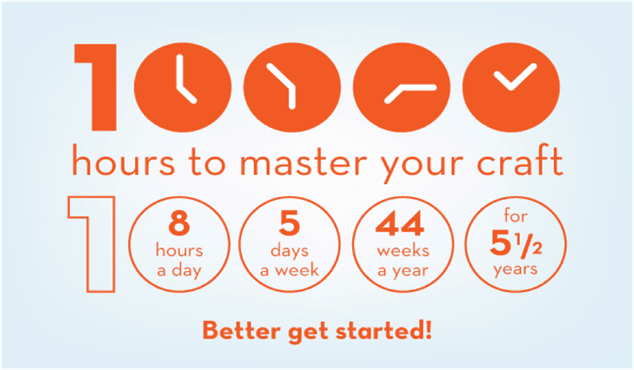

In the book Outliers: The Story of Success, Malcolm Gladwell studied the “outliers” — i.e. the most successful people of the world, including sportsmen, business people, musicians and scientists, to understand the key factors behind their success. He found the key denominator to all their success isn’t natural aptitude as many like to believe. Having a high IQ doesn’t guarantee success: there is supposedly no difference in people’s propensity to succeed beyond an IQ of 130.
The key denominator is actually hard work. A lot of it, in fact. About 10,000 hours of it. That’s roughly 3 hours every day, for 10 consecutive years, before any one of them began to be seen as the “expert” in their field.
This finding isn’t shocking. I feel the concept of natural talent has become overrated, along with self-discipline. Oftentimes, I see people letting go of their dreams because they claim they do not have the “talent.” Having an innate ability is definitely a nice bonus and a great enabler, but the role it plays is lesser than what many may think.
While having an aptitude does get one an initial head start — for example if you are naturally good at drawing, that gives you an edge over others when starting out — beyond a certain stage, success becomes increasingly dependent on your attitude and the amount of work you put in than your aptitude. Hard work becomes the key determinant of your success in the long haul. As Thomas Edison puts it: “Genius is 1% inspiration and 99% perspiration.”
As Malcolm Gladwell has found, even in fields like sports and music where many see the key to success as having an innate ability, consistent hard work has proven to be the more superior factor by far. This is the case even for established names like Tiger Woods, Michael Jordan, Magnus Carlsen, Bill Gates, The Beatles & Beethoven. For most (if not all) of them, their hard work started right as a kid. It was through relentless training since they were young before they attained their kind of expertise today.
🪄Examples of How Top Performers Developed Their Talent Through Hard Work:
- The Beatles burst onto the world stage in the 1960s, seemingly lifted from their hometown of Liverpool and dropped into the world’s biggest venues. But theirs was not an overnight success. One of the Beatles’ early gigs was performing near military bases in Hamburg, Germany; they would perform for eight hours a day, seven days a week. They did this for 270 days over the course of 18 months. By the time the Beatles enjoyed their first commercial success in 1964, they had performed 1,200 times, which is more than most bands today perform in their careers. When the Beatles first left for Germany, they weren’t very good. But by the time their Hamburg stints ended, they sounded like no other band in the world. They were well on their way to getting in their 10,000 hours.
- Generally regarded as a savant or a computer genius, Gates has a 10,000-hour story, too. Gates had the good fortune to attend a private school in Seattle that had a computer club. This was 1968 when most universities did not have a computer club. And Gates’ club didn’t have an ordinary computer — they had an ASR-33 Teletype, one of the most advanced computers of its day. Gates was hooked on computers and began programming in the eighth grade! This led to other experiences in Seattle, and by the time he graduated, Gates had practically lived in the computer lab for five years. He was closing in on 10,000 hours and was ready to take full advantage of the opportunities he soon would receive.
- There are similar examples: Bill Joy, computer legend and founder of Sun Microsystems; Mozart, whose greatest compositions weren’t written until he had been composing for more than 20 years; and it takes roughly 10,000 hours to become a chess master.
Does this mean that everyone who is successful in their niche is so because they have invested exactly 10,000 hours? No, not necessarily. Some might have put in fewer hours, some more. The 10,000 figure should be seen as a reference point. The amount of work needed depends on the size of your goal. The bigger your goal, the more work required. If you want to be internationally renowned in your field, meaning surpassing all other people who are also working their butts off to carve a name for themselves, then 10,000 hours is definitely a minimum commitment. I’d say that learning and mastery never ends and it’s a matter of striving to be better than you are now.
👨💻My Coding Skill — 14,400 Hours, and Counting
Me, I’ve been coding professionally for the past 6 years. If you assume that I spend an average of 8 hours per day coding (I definitely spend more time than that on many days; sometimes I can be coding the whole day), that’s 8 hours x 300 days (as oftentimes I’m learning or coding on weekends too) x 6 years = 14,400 hours. Here, “coding” applies to analysis, creating designs, learning new technologies & practices, taking a course, writing code, struggling with bugs, facing burnout, etc. That’s 14,400 hours, which is a lot of time.
While I’m far from an expert, I can see how my approach to coding has changed over the years — in a good way.
- While at the beginning I would struggle with writing/debugging/improving software, now I can better tell when a project is heading in the right direction and how to steer it in that direction.
- While I used to struggle a lot with errors and syntax, now I’m able to jump right in.
- While at the beginning I would only know whether a software feature would be well-received or not after deploying it, now I can sort of tell how the users/client would receive it, and consequently shape my deliveries to get the best impact.
- I’m now able to code more productively. I used to get “stuck” in errors sometimes — where nothing I do sticks and the more I try to debug the worse it becomes. Now I know how to get into the right state to fix bugs, and when to stop and rest.
- I know what are the best environments to help me get into the flow — and the ones that don’t. This means I’m more strategic about changing/creating the right environment to get into the deep focus zone.
Overcoming each bump takes experimentation and self-awareness. Sometimes there’s a lot of pain involved. But I find that each time I overcome an obstacle, it becomes easier. It’s as if I’ve just unlocked a new aspect of writing code that I didn’t know before. And I only got to know this because I’ve done the grunt work.
I’ve observed the same thing with other skills too — teaching, speaking, blogging, and playing guitar. There’s always the initial struggle. And the self-doubt / mental blocks where you know your desired output but you aren’t quite sure how to make it happen. And then there’s the “messy” stage where you are deep in the trenches trying to figure things out. And slowly you are able to “swim” and create some semblance of results. And gradually you see things at a more strategic level and learn how to go from vision to end outcome in the most effective & efficient way.
💡Other People’s Skills
If I look at the people around me, the same applies to them. All their skills have been acquired through time, hard work, and experience. I genuinely can’t think of anyone who is just “born” with their skills. Perhaps some people may think that they were “born” with their skills, but when you dig deeper, the opposite is true.
So why do so many people think of talent as being something innate that only some have? I suspect one reason is that the media tends to romanticize the successes of the “have’s.” They make them seem like magical beings who have special powers that we “mere mortals” don’t have. Another reason is that people usually only see top performers when they have achieved certain expertise. They don’t see endless hours invested before this expertise is attained. Without knowing that, it’s easy to jump to conclusions and assume that they have always been this good all along.
🎯Just Putting 10,000 Hours is NOT Enough
10,000 hours is the rule of thumb popularized by Malcolm Gladwell but 10,000 hours of practice by itself is not sufficient. There are 4 additional criteria that must be met and in cases when these criteria aren’t met, it’s impossible to become an expert.
1️⃣Repeated Experience With Same Events
We have all experienced that magic moment when, after days, months, or even years of practising something, we nail it: we score the perfect three-point-shot in basketball, our hands come together to complete a flawless Mozart sonata on the piano, or we manage to parallel park the perfect distance from the curb on a crowded street. This is the “magic” of Repeated Experience With Same Events.
But you also need to get feedback on these events. So you know how you are progressing as a learner & also to help you know what are the areas you need to study or practice more. The key to mastering a skill is to keep repeating it multiple times and get slightly better each time you do it.
Here are some examples of various skillsets & how they receive feedback:
| Skillset | Feedback |
|---|---|
| Tennis Players | They hit hundreds of forehands in practice and see if each shot clears the net & is in or out |
| Chess Players | Play thousands of games and see if they win or lose the game or improve their positions |
| Physicists | Solve thousands of physics problems and see if they get the problem right or wrong |
| Software Engineers | Write thousands of lines of code, practice design patterns, algorithms and solve problem statements then they get feedback from the compiler, during code review or from the client if their solutions have accurately solved the problem |
| Musicians | They practice for thousands of hours to improve their theory knowledge, scales, harmonies and styles. They get feedback through self-awareness, playing in front of an audience or recording their sessions |
2️⃣Valid Environment
The next requirement is a valid environment, one that contains regularities that make it at least somewhat predictable. A gambler betting at a roulette wheel, for example, may have thousands of repeated experiences with the same event. For each one, they get clear feedback in the form of whether they win or lose but you wouldn’t consider them an expert because the environment is low validity. A roulette wheel is essentially random so there are no regularities to be learned.
We have a hard time accepting average results and we see patterns everywhere, including in randomness. So we try to beat the average by predicting the pattern. But when there is no pattern, practising for 10,000 hours is a terrible strategy if you’re not in a valid environment. If there are no patterns or areas to study which can be studied repeatedly to yield better results. Example – Roulette wheel, lottery tickets, the stock market (to some extent).
3️⃣Timely Feedback
Even when there are patterns, you need timely feedback in order to learn them.
To understand the difference between immediate & delayed feedback psychologist Daniel Kahneman contrasts the experiences of anesthesiologists & radiologists. Anesthesiologists work alongside the patient and get feedback straight away as they can see if the patient is unconscious with stable vital signs. With this immediate feedback, it’s easier for them to learn the regularities of their environment. Radiologists, on the other hand, don’t get rapid feedback on their diagnosis if they get it at all. This makes it much harder for them to improve. Radiologists typically correctly diagnose cancer from just x-rays just 70% of the time.
Delayed feedback also seems to be a problem for college admission officers and recruitment specialists. After admitting someone to college or hiring someone at a big company, you may never, or only much later find out how they did. This makes it harder to recognize the patterns in ideal candidates.
This is why you need a mechanism to provide you timely or immediate feedback to improve whatever skill you’re practising.
4️⃣Deliberate Practice
So, if you’re in a valid environment and get repeated experience with the same events with clear, timely feedback from each attempt will you definitely become an expert in 10,000 hours or so?
The answer unfortunately is NO because most of us want to be comfortable. For a lot of tasks in life, we can become competent in a fairly short period of time.
Take driving a car for example, initially, it’s pretty challenging, it takes your entire attention but after 50 hours or so it becomes automatic and you can do it without much conscious thought. After that, more time spent driving doesn’t improve performance. If you wanted to keep improving you would have to try driving in challenging situations like new terrain, higher speeds or in difficult weather.
Now I’ve played the guitar for 12 years but I’m not an expert because I usually play the same songs because it’s easier and more fun. But in order to learn, you have to practice at the edge of your ability, pushing beyond your comfort zone. You have to use a lot of concentration and methodically repeatedly attempt things you aren’t good at.
This is known as Deliberate Practice. In many areas, professionals don’t engage in deliberate practice so their performance doesn’t improve. In fact, sometimes it declines.
Checkout the deliberate practice guide to learn more – https://fs.blog/deliberate-practice-guide/
🔊Start Investing Your 10,000 Hours Today
Do you have a goal that you feel you lack the talent to achieve it? Believe it or not, you already have the aptitude required to achieve your goal. The missing piece of the puzzle is not the lack of talent, but your readiness to put in the grunt work.
Rather than seeing talent as something innate in certain people, recognize that talent is innate in you too. You just need to put in the hours to bring this “talent” out of you. If you start seeing that Talent = Aptitude + Hard work, where aptitude is already present in everyone and hard work is the real variable in the equation, you will start to have a lot more power over your goals.
Moving ahead,
- What are the areas you want to be talented in? Identify them.
- How do you plan to put in your 10,000 hours? How many hours can you invest every day? Draw out a plan.
- How can you get started on this new plan? Work out your schedule.
Start clocking hours. Soon, you will become the top talent in your field.


Leave a comment